
What the Federal Budget Means for First Home Buyers and Property Investors


The latest Federal Budget has put housing at the centre of the national agenda — and for first home buyers and investors, the direction is clear: more support for home ownership, more focus on new housing supply, and stronger incentives to make smarter property decisions.
Rather than seeing the Budget as a reason to wait, buyers and investors should see it as a prompt to get organised.
What’s Changing?

One of the headline measures is the Government’s proposed reform of negative gearing and capital gains tax. The Government estimates these changes could support around 75,000 additional homeowners over the next decade.
The Budget also includes a new $2 billion Local Infrastructure Fund to help councils and utilities build the roads, water, power and sewerage infrastructure needed to unlock new housing. This is expected to support up to 65,000 homes over the decade.
For first home buyers, this is positive because affordability is not just about grants or borrowing power — it is also about supply. More homes, better infrastructure and less competition for established properties can all help create a more balanced market over time.
Benefits for First Home Buyers

The Budget extends the ban on foreign buyers purchasing established homes until mid-2029. Combined with tax changes aimed at shifting investor demand toward new builds, this may help reduce competition for some established homes — the type of property many first home buyers are trying to purchase.
But policy support alone is not enough. First home buyers still need to understand their borrowing power, deposit options, pre-approval position and suburb strategy before they enter the market.
That is where preparation matters. At Property Investment Coaching, we help first home buyers work through the buying journey step by step: calculating their budget, researching the market, securing pre-approval, inspecting properties, making offers and moving through settlement with confidence.
Benefits for Investors
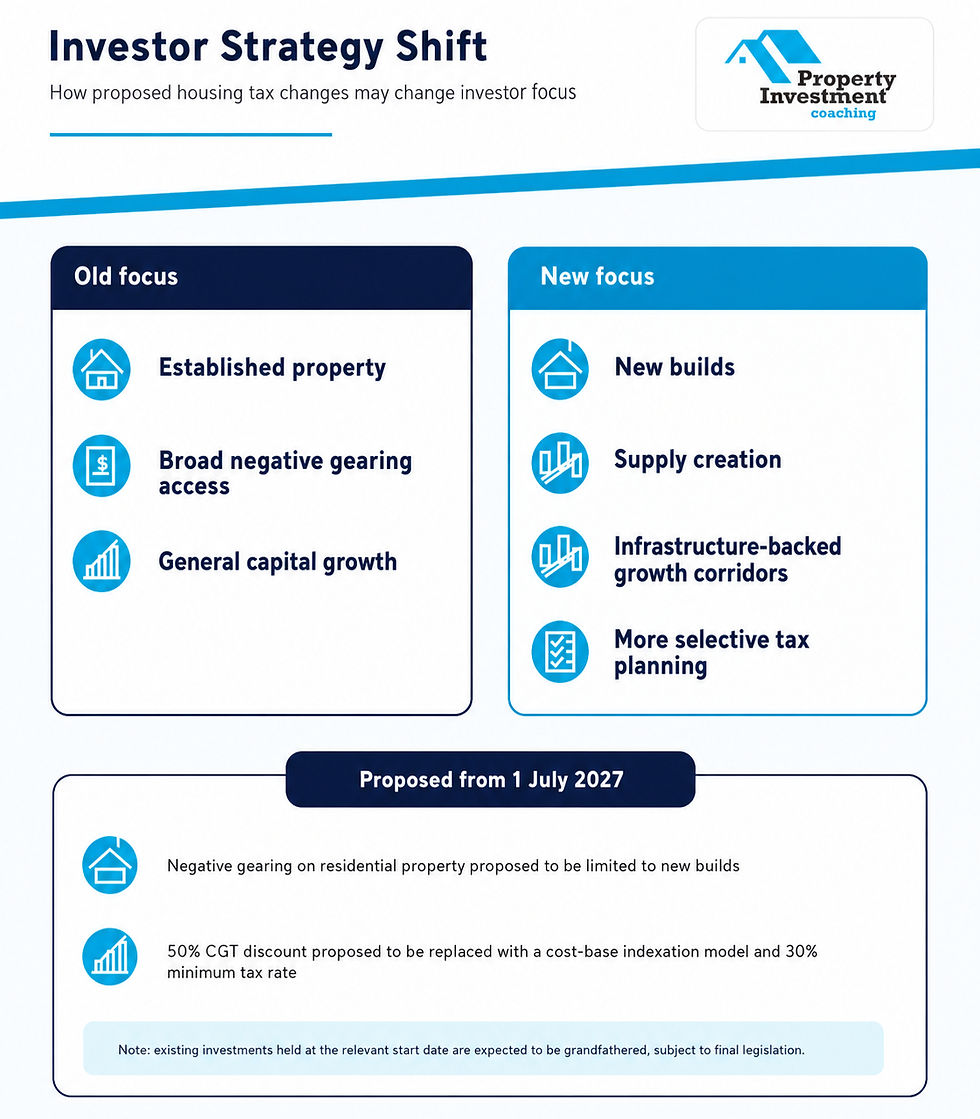
For investors, the Budget sends a clear signal: new housing supply is becoming more important.
From 1 July 2027, the Government proposes to limit negative gearing for residential property to new builds. Existing investments held before the relevant Budget date are expected to be grandfathered, but investors buying established properties in the future may not receive the same tax treatment.
The proposed CGT changes are also important. From 1 July 2027, the current 50% CGT discount is proposed to be replaced with a cost-base indexation model and a 30% minimum tax rate on capital gains.
This does not mean investors should stop investing. It means investors need to be more selective. New builds, land-and-build packages, subdivisions and development opportunities may become more attractive where they are supported by strong fundamentals.
The Real Opportunity: Better Suburb Selection

The Budget creates a positive environment for people who make informed decisions. But not every new property is a good investment, and not every affordable suburb is a growth suburb.
Investors should be asking: Is infrastructure improving? Is demand real? Is the suburb underpriced compared with nearby areas? Is there a long-term reason people will want to live there?
This is where Property Investment Coaching’s data-led approach is valuable. We look beyond headlines and focus on the numbers, local knowledge and suburb fundamentals that help buyers and investors make better decisions.
What Should You Do Now?
First home buyers should use this moment to get clear on their budget, deposit and buying strategy.
Investors should review whether their next purchase is aligned with the future direction of the market — particularly the shift toward new housing supply.
The Federal Budget has created a more positive conversation around housing. The opportunity is there, but the best results will come from taking practical, informed steps early.


Comments